
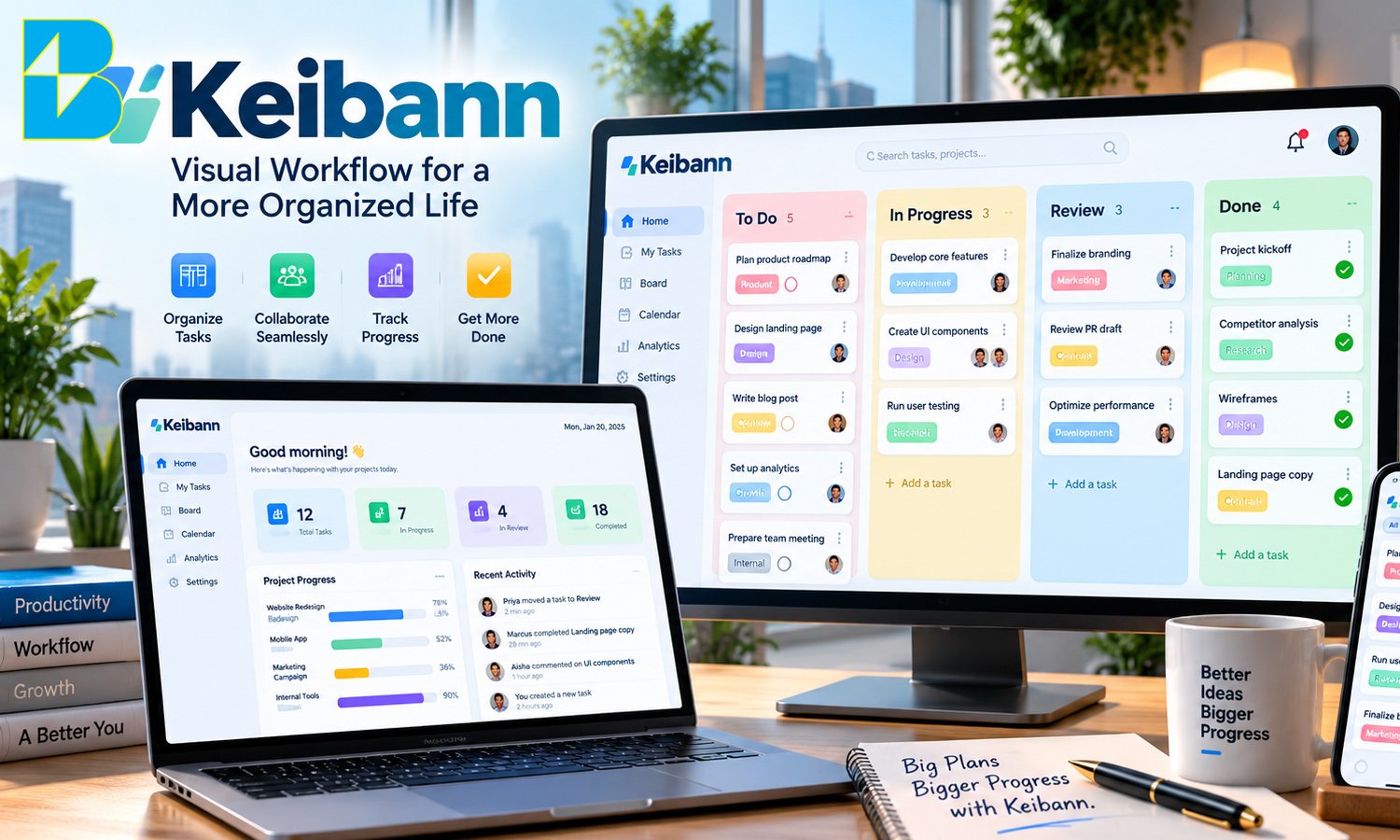
Keibann is a word that keeps showing up in blog posts and search results, yet no dictionary, company, or standards group has given it an official definition. Most online writers connect it to Kanban, the visual task board system that started at Toyota. A few others link it to small Japanese kei cars, and some treat it as a brand name or a simple typo. This guide sorts out each meaning, explains how Kanban really works, and shows you how to build a simple board of your own. You will also learn what to check before you trust any page that makes big claims about Keibann.
What does Keibann mean?
Keibann has no single official meaning, so what it means depends on where you see it. Search results show three main uses. Most pages describe it as a visual way to plan tasks, much like a Kanban board. A smaller group of pages connects it to compact Japanese cars called kei cars. A third group treats it as a general online term, a possible brand name, or a digital project without a clear owner.
The pages that cover this word agree on one thing: nobody has set a standard definition. One review site says plainly that no verified feature list exists because there is no officially confirmed version of Keibann. Other writers say they found no proof that Keibann is an official Japanese word, a business method, or an industry category.
That missing definition may feel frustrating, but it gives you a simple rule. Treat Keibann as a label that needs context. If the page talks about tasks, columns, and teams, the writer means a board style workflow. If the page talks about engines, tiny trucks, and yellow license plates, the writer means kei vehicles. If the page gives no context at all, read it with care.
Some readers wonder if the word comes from keijiban, the Japanese word for a bulletin board. No source we reviewed confirms that link, so treat it as a guess and not a fact. A plain typo of Kanban is another possibility. The honest answer is that the origin is unclear.
Is Keibann the same as Kanban?
No, Keibann and Kanban are not the same thing, even though many pages use the first word to describe the second idea. Kanban is a proven method with a known inventor, a documented history, books, training groups, and decades of use in factories and software teams. Keibann has none of that. One writer puts it well by calling Keibann an emerging concept instead of another official name for Kanban.
The two words look alike, and that causes most of the confusion. Several pages that describe Keibann copy the same ideas you would find in any Kanban guide: columns, cards, and a focus on making work visible. When you read those pages, you are really learning about Kanban with a different spelling.
This matters if you plan to use the method at work. If you search for Keibann training or Keibann software, you will find very little that is reliable. If you search for Kanban, you will find tested guides, free templates, and tools from major companies. Learn the real method first. You can call your own board whatever you like once you understand how it works.
Where does the word Kanban come from?
Kanban is a Japanese word that means visual signal, signboard, or card. Taiichi Ohno, an industrial engineer at Toyota, developed the system in the late 1940s and early 1950s to make car production more efficient. Toyota needed to cut waste. Parts and materials sitting unused in storage cost money and slowed the whole factory.
Ohno found his idea in an American supermarket. Stores restock a product only after customers buy most of it, so shoppers pull items off the shelf and demand drives supply. Ohno decided a factory could work the same way. Instead of pushing large batches of parts down the line, each step would ask for more parts only when it needed them.
To send that request, Toyota used cards. When a container of parts ran low, a card traveled back to the previous step as a signal to make more. This approach became known as just in time production, and it became a core part of the Toyota Production System. Toyota also set six simple rules for using the cards and watched them closely, because a loose system would stop working.
The idea did not stay in factories. Later, a consultant named David J. Anderson adapted Kanban for knowledge work such as software development. His version uses the same visual signals, but the cards now stand for tasks, not car parts. Today teams in marketing, education, design, and many other fields run their work on Kanban boards.
How does a Kanban style board work?
A Kanban style board shows every task as a card that moves across columns as the work moves forward. The simplest board has three columns: To Do, In Progress, and Done. Many teams add more, such as Ideas and Review. One article about Keibann suggests exactly this setup, with columns named Ideas, To Do, In Progress, Review, and Done.
Here is a simple example. Say you run a small blog. You write each post idea on a card and place it in the Ideas column. When you decide to write one, you move it to To Do. When you start drafting, the card moves to In Progress. After you finish the draft, you move it to Review so you or an editor can check it. Once you publish, the card goes to Done.
The board works because everything is visible. You do not need a meeting to learn what is happening. You look at the board and see which tasks are waiting, which are active, and which are finished. This also means you can spot problems fast. If ten cards pile up in Review and nothing moves to Done, you know the review step is slowing you down.
The board also uses a pull approach, which comes straight from Ohno’s supermarket idea. You pull a new task into In Progress only when you have room for it. You do not push every task into the active column on the first day and hope for the best.
What are the main parts of a Kanban style board?
A Kanban board has a few core parts: cards, columns, and limits on work in progress. Anderson described the board as having five components, and each one has a clear job.
- Visual signals. These are the cards. Each card stands for one task and can show a name, a due date, and the person who owns it.
- Columns. Each column stands for one stage of your workflow. Cards move from left to right as the work advances.
- Work in progress limits. A limit sets the maximum number of cards allowed in a column at one time.
- A commitment point. This is the moment when a task leaves the waiting list and the team agrees to do it.
- A delivery point. This is the end of the workflow, where finished work reaches the customer or reader.
The work in progress limit gets the most attention, and for good reason. It forces you to finish tasks before you start new ones. It also warns you early when you promised too much. When a column hits its limit, you must clear a card before you add another. That rule exposes bottlenecks while they are still small.
Why do some pages link Keibann to Japanese kei cars?
Some pages link Keibann to kei cars because the spelling looks close to the word kei, which means light in Japanese. Kei jidosha is the official Japanese term for a light automobile, and the category covers the smallest road legal cars, vans, and trucks in Japan. A few websites mention Keibann in the same breath as kei vehicles and kei vans.
No reliable source proves a direct connection between the two. The link seems to come from how the words look, and not from any shared history. So if you meet Keibann in an article about cars, treat it as a loose reference and not a technical term. Look for the standard words kei car or kei jidosha when you want accurate information about these vehicles.
What rules define a kei car?
A kei car must meet strict limits on size and engine power set by the Japanese government. The current limits are 3.4 meters (11.2 feet) in length, 1.48 meters (4.9 feet) in width, and 2.0 meters (6.6 feet) in height. The engine cannot exceed 660 cubic centimeters. A kei vehicle can carry up to four people and a maximum load of 350 kilograms (772 pounds).
Japan created the category in 1949 to help more people own cars and to grow its car industry. The first limits were tiny, with an engine cap of just 150 cubic centimeters. Lawmakers raised the limits several times over the years. The engine cap reached 660 cubic centimeters in 1990, and the size limits took their current form in 1998.
Power is a common point of confusion. Japanese law sets no official horsepower limit for kei cars. Instead, car makers agreed among themselves to keep engines at about 64 horsepower, mainly to avoid a race for more power.
In return for accepting these limits, kei owners get lower taxes, cheaper insurance, and easier rules for proving they have a parking space. Kei cars wear yellow license plates, which is why English speakers sometimes call them yellow plate cars. They have also become a big part of the Japanese market. They make up just over one third of new car sales. Popular tall, boxy models such as the Honda N-Box, Suzuki Spacia, and Daihatsu Tanto give families a lot of space inside a small frame.
How can you build your own Keibann style board?
You can build a working board in about ten minutes with a whiteboard, a wall and sticky notes, or a free app. Follow these steps.
- Choose your space. Pick a physical wall or a digital tool. A physical board is great for a home or small office. A digital board works better for remote teams.
- Draw your columns. Start with three: To Do, In Progress, and Done. Add Review or Ideas only if you truly need them. Atlassian lists too many columns as a common mistake.
- Write one card per task. Keep each card small enough to finish in a few days. Add a name and a due date.
- Set a limit for In Progress. A team of four people can start with a limit of four to six cards. If you work alone, try two or three. You can adjust the number later.
- Move cards every day. Spend two minutes each morning updating the board. An old board that nobody touches is worse than no board.
- Review once a week. Look for cards that have sat in one column too long. Ask why they stalled and fix the cause.
Start small and change the board as you learn. The best board is the one your team actually uses.
What benefits can a visual board give you?
A visual board makes work easier to see, follow, and organize. Here are the main benefits.
- Clear status at a glance. Everyone sees what is waiting, active, and done without asking.
- Faster bottleneck spotting. A pile of cards in one column shows exactly where work gets stuck.
- Less multitasking. Limits on work in progress push people to finish tasks instead of juggling many at once.
- Better teamwork. A shared board gives the whole team the same picture, which cuts down on status meetings and long message threads.
- Flexibility. You can add, remove, or reorder cards when priorities change, without rebuilding a whole plan.
Individuals gain from the same approach. You can use a board to plan study topics, home projects, a job search, or a side business. The method does not depend on a big team or special software.
What mistakes should you avoid?
The most common mistake is making the board too complicated. Atlassian lists four problems that show up again and again: adding too many columns, skipping limits on work in progress, letting tasks sit too long without review, and treating the board like a fixed to do list instead of a living workflow tool.
A fifth mistake is expecting the board to fix a weak process by itself. A board only shows you the truth about your work. If tasks are unclear or priorities keep changing, the board will show that too, and you still need to fix those problems yourself. Another mistake is chasing a trendy name. Calling your system Keibann will not make it work better. Clear columns, honest limits, and regular reviews will.
How can you judge pages that write about Keibann?
Check whether the page admits that Keibann has no official definition, because honest pages say so. Many articles about this word sound confident, yet they cannot name a founder, a company, a book, or a standard behind it. Here are a few quick checks.
- Look for named sources. Reliable pages point to real organizations, books, or experts.
- Watch for vague claims. Phrases that promise big results without examples are a warning sign.
- Compare with Kanban sources. If a page repeats basic Kanban facts under another spelling, you can learn from it, but you should confirm the facts elsewhere.
- Be careful with downloads and payments. If a site asks you to install software or pay for something called Keibann, research the seller first. No verified product exists under that name.
These habits protect your time and your money, and they work for any new term you meet online.
Conclusion
Keibann has no official meaning today. Most writers use it to describe a Kanban style board, and a few connect it to Japanese kei cars. If you want a tool you can trust, learn Kanban, build a simple board, set sensible limits, and keep it updated.
Frequently Asked Questions
What is Keibann in simple words?
Keibann is an online term without an official definition. Most pages use it to describe a visual task board, where cards move through columns like To Do, In Progress, and Done. Some pages link it to Japanese kei cars. Always check the context of the page to see which meaning the writer intends.
Is Keibann a real Japanese word?
No source we reviewed shows that Keibann is an officially recognized Japanese word. It may be a spelling variation of Kanban or a loose link to the word kei. Real Japanese terms with similar sounds, such as kanban and kei jidosha, have clear meanings and long histories.
What is the difference between Keibann and Kanban?
Kanban is an established method that Taiichi Ohno developed at Toyota and David J. Anderson later adapted for knowledge work. It has clear rules, such as limits on work in progress. Keibann has no formal rules, no known founder, and no standard training, so writers mostly use it as another spelling of Kanban.
Can I use a Keibann style board for personal tasks?
Yes. You can use a board for study plans, home projects, meal planning, or a job search. Draw three columns, write one card per task, and limit how many cards sit in progress. Because the method is simple, a notebook page or a wall with sticky notes works just as well as an app.
Is Keibann safe to use?
The word itself is harmless, but no verified Keibann product or service exists. Be careful if a website asks you to download software, create an account, or pay for something called Keibann. Research the company first, read independent reviews, and choose tools with a clear owner, such as well known Kanban apps.