
Cevurı is a word that confuses many readers, because every website tells a different story about it. Some pages call it a slowly cooked Turkish stew. Others say it is a business idea, a symbol of change, or a joke about bad translations. We checked dictionaries, food references, and recent articles to sort fact from guesswork. The short answer is that Cevurı is not a standard Turkish word, and no strong source proves it is a traditional dish. Most evidence links it to the Turkish word çeviri, which means translation. This guide explains what we found, shows where the dish claims come from, and introduces real Turkish clay pot dishes that you can cook at home today.
What does Cevurı mean?
Cevurı most likely means “translation,” because it looks like a changed spelling of the Turkish word çeviri. Several recent articles make this link. Visto Magazine calls Cevurı an internet keyword tied to translation memes. Jovira describes the çeviri connection as the strongest explanation among all the theories it reviewed. Uploadblog says people use it as an informal online version of the Turkish word.
The sources do not agree on everything, so treat this meaning as the best guess, not as a proven fact. A few sites say Cevurı means transformation. A few others say it names a food. We will look at each claim in the sections below. For now, remember one simple rule: the word has no official definition, so its meaning depends on who is writing.
Is Cevurı a real Turkish word?
No, Cevurı is not a standard word in Turkish. We checked the main dictionary sources that English speakers use for Turkish. The Cambridge English to Turkish Dictionary lists çeviri and tercüme as the words for translation. Wiktionary lists çeviri as a Turkish noun that means translation and rendition. Tureng, a popular Turkish and English dictionary, lists çeviri with the same core meaning. None of these sources lists Cevurı.
Other writers reached the same result. One guide on language use states plainly that Cevurı is not a real word in Turkish and says it appears as a simple misspelling. Another says the term is not officially recognized, even though people use it online.
This does not mean the word is useless. Internet users invent new spellings all the time, and some of them catch on. It only means you should not call Cevurı a correct Turkish word in school work, in a translation job, or in a food blog that wants to stay accurate.
Where does the word Cevurı come from?
Cevurı most likely comes from çeviri, a Turkish noun built from the verb çevir, which means “to translate.” Wiktionary explains that çeviri forms from that verb plus a common noun ending. The Turkish verb çevirmek also means to turn something, which is why Turkish speakers say they “turn” a text into another language.
The spelling change tells an interesting story. Turkish uses the letters ç and ı, and many keyboards outside Turkey do not show them easily. Typists often swap ç for c and use a plain i or a similar letter instead. That explains the c at the start of Cevurı and the dotless ı at the end.
It does not fully explain the u in the middle, though. Çeviri has an i there, and Cevurı has a u. This small gap is the reason we call the link likely, not proven. Maybe someone made a typing slip, maybe someone changed the word on purpose for fun, or maybe the word has a second source that nobody has documented yet. Until a reliable record appears, the çeviri theory remains the simplest and most popular answer.
Why do so many people search for Cevurı?
People search for Cevurı because dozens of blogs published articles about it in 2025 and 2026, and curiosity grew from there. Articles with titles like “Why Everyone Is Searching for Cevurı” and “Why It Is Trending in 2026” appeared on several small sites. Each new article gave readers one more reason to look up the word.
Our reading of the pattern is simple. A new and unusual word shows up in search tools. Publishers see that people are curious, so they write about it quickly. Many of them copy ideas from each other, and some fill the gaps with made up details. The result is a pile of articles that sound confident but contradict each other.
That is why a careful reader should ask a basic question about every claim: where did this writer get the information? In most Cevurı articles, the answer is “from other blogs,” and that is a weak foundation.
Is Cevurı a traditional Turkish dish?
No reliable source proves that Cevurı is a traditional Turkish dish. Still, many websites describe it that way, so the claim deserves a fair look.
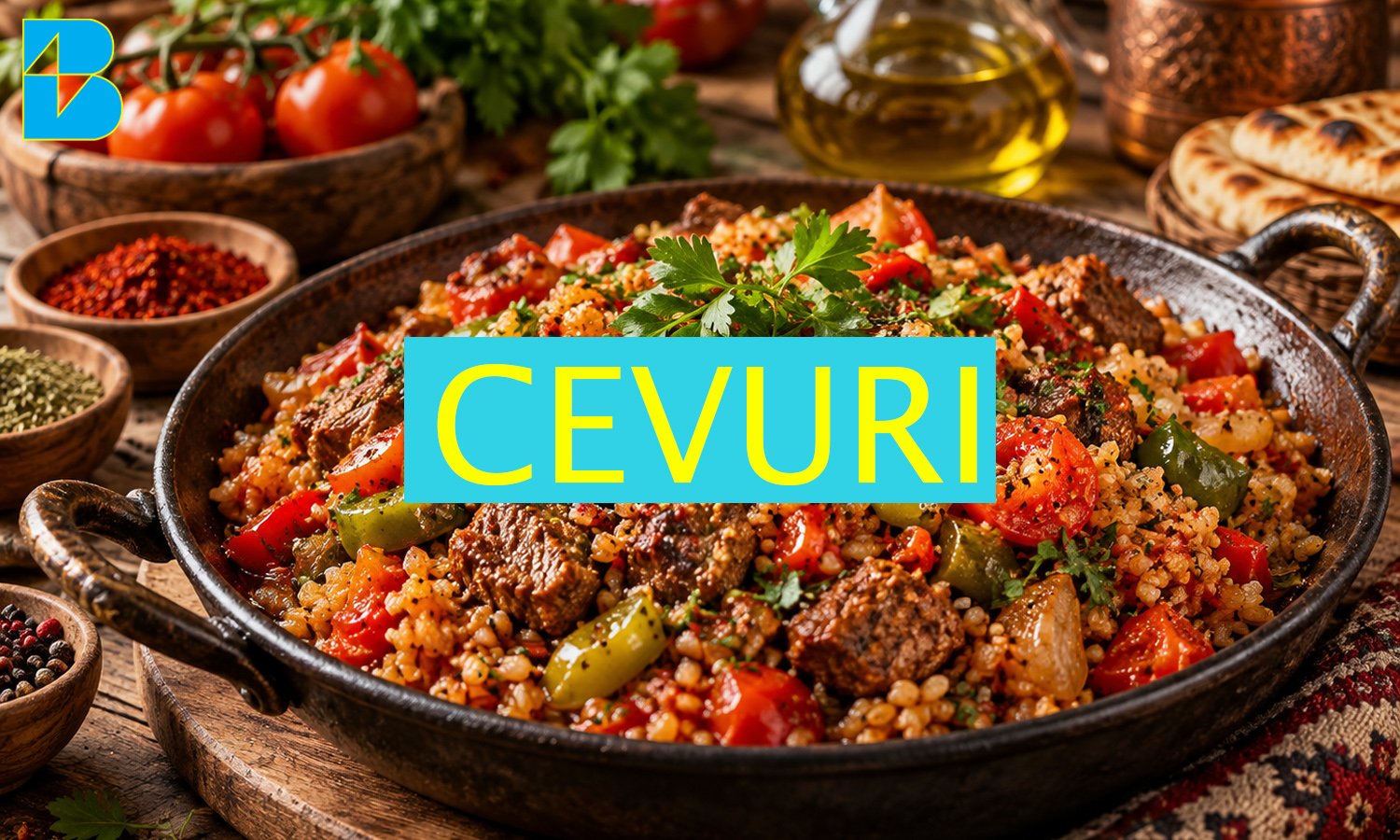
The descriptions share a few themes. Street63 calls Cevurı a Turkish meat dish made with marinated lamb, spices, and slow cooking. Riverwood Naples describes an Anatolian style dish of slowly cooked meat, vegetables, and grains. Binge Saga says the dish has roots in Central Asia and Anatolia and pairs lamb or chicken with eggplants, tomatoes, and rice or bulgur. A fitness studio blog describes a simple homemade meal of vegetables, grains, or legumes with light spices and healthy oils.
Now notice what is missing. None of these pages names a cookbook, a historian, a regional chef, or a Turkish source. None gives an old recipe or a clear region where people cook it. Without those details, the dish claims read more like general praise of Turkish home cooking than like a documented food history.
One site that reviewed the topic carefully reached the same view. It said it could not verify Cevurı as an established dish name in the authoritative Turkish culinary sources it checked. Another article noted that several blogs mention the dish but that the claim is not widely verified.
Why do the food descriptions disagree?
The food descriptions disagree because no real dish stands behind them. When a food has a long history, its basic identity stays stable even if the details change from town to town. People who say “kebab” or “pilaf” argue about spices, not about whether the dish uses meat or rice. The Cevurı descriptions do not show that kind of stability.
Look at the differences. One source says the dish is mainly meat, while another describes grains and legumes with little or no meat. One site says cooks sauté it, and others say they simmer or stew it. Some writers place its roots in rural Anatolia, and others place them in Central Asia. These details describe quite different foods, which suggests writers invented them to fit the word.
This pattern is common with new keywords. A writer needs 1,000 words about a topic. The writer knows Turkish food has a good reputation, so the article fills with words like “rustic,” “heritage,” and “comfort.” The text sounds warm, but it carries almost no checkable facts. You can spot this style quickly once you know to look for it.
Which real Turkish dishes match the Cevurı descriptions?
Several real Turkish dishes match the slow cooked, clay pot picture that Cevurı articles paint, and the best known is güveç. The word güveç names both a family of earthenware pots and the stews cooked inside them. Wikipedia notes that people use these pots across Balkan, Persian, Turkish, and Levantine cooking. It also reports that the town of Sorkun has made the pots from local clay for centuries.
Kuzu güveç is the dish most people have in mind. “Kuzu” means lamb, so the name means lamb stew or lamb casserole. Cooks layer lamb with vegetables such as eggplant, peppers, and tomatoes, then bake it slowly until the meat turns soft. Food writers describe it as a home style dish found in simple Turkish restaurants, and recipes change from region to region.
Testi kebabı is another real dish with a strong story. It comes from Cappadocia, where cooks seal meat and vegetables inside a clay pot called a testi. They cook it over a slow fire, often in a tandır oven, and then break the pot at the table. The ritual makes it one of the most dramatic meals in Anatolian cooking.
Yahni is a third example. Wikipedia explains that yahni is a stew of meat, fish, or vegetables built on browned onions, tomatoes, and olive oil. The name came into Ottoman Turkish from Persian, and it traces back to the covered clay pot used to cook it. People often serve it with rice or bulgur.
If you came to this page hoping to eat something, these dishes give you real names, real histories, and real recipes. Search for them instead of Cevurı and you will find far better information.
How can you cook a Turkish style lamb stew at home?
You can cook a Turkish style lamb stew at home by layering lamb and vegetables in a pot and baking it low and slow. This method follows the kuzu güveç tradition, and it works in a clay pot, a cast iron pot, or a covered Dutch oven.
Here is a simple plan for about four servings. It uses ingredients that recipe writers commonly list for kuzu güveç.
- 2 pounds of boneless lamb shoulder, cut into large cubes
- 2 medium onions, chopped
- 4 cloves of garlic, sliced
- 2 tablespoons of Turkish pepper paste and 1 tablespoon of tomato paste
- 3 ripe tomatoes, chopped
- 1 eggplant, 2 potatoes, and 2 long green peppers, cut into chunks
- 1 teaspoon of dried thyme or oregano
- 1 teaspoon of Aleppo style pepper flakes, salt, black pepper, and olive oil
Follow these steps:
- Soak the pot and lid in cold water for 30 minutes if you use unglazed clay. Skip this step for cast iron.
- Heat a little olive oil and brown the lamb for a few minutes. Many traditional cooks skip browning, so you can skip it too.
- Layer the onions, lamb, pastes, vegetables, and herbs in the pot. Add about 1½ cups of hot water or broth, plus salt and pepper.
- Cover the pot and bake it in a low oven, around 300 to 325 degrees Fahrenheit, for roughly two and a half to three hours. Cooking times change with the pot and the cut, so test the lamb with a fork.
- Rest the stew for 10 minutes. Serve it with rice, bulgur, or fresh bread and a simple salad.
Lamb shoulder works best because it turns soft and flavorful during long cooking. If you prefer, you can use beef or chicken, but remember that chicken cooks much faster.
Does Cevurı mean anything in business or personal growth?
Some websites use Cevurı as a business or self improvement idea, but these uses are personal interpretations, not established terms. One article claims the word describes how startups turn ideas into scalable results. Another treats it as a symbol of personal change, courage, and cultural adaptation. A third says companies use it to adapt products and marketing for different cultures.
These ideas are not entirely random. If Cevurı comes from çeviri, then “translation” and “conversion” are natural themes, and a writer can stretch them into stories about change. A business team really does need to translate strategy into action, and a person really does change over time.
Still, no research paper, company report, or industry standard uses Cevurı for these ideas. So you can enjoy the metaphor, but you should not present it as a recognized framework. If you write for work or school, use the plain words “translation,” “adaptation,” or “transformation” instead. Your readers will understand you right away, and you will avoid sounding like you invented a term.
How can you check if a food name or foreign word is real?
You can check a foreign word or food name with a few simple steps that take about ten minutes. These steps work for Turkish words and for words from any other language.
- Check a trusted dictionary. For Turkish, try the Cambridge English to Turkish Dictionary, Wiktionary, or Tureng. The Turkish Language Association, known as TDK, publishes the official Turkish dictionary. The Nişanyan Dictionary, written by Sevan Nişanyan, explains where Turkish words come from.
- Search the original spelling. Type the word with the right letters, such as ç, ı, ş, ğ, and ö. If the proper spelling shows no results but the simplified one does, the word may be an online invention.
- Look for independent sources. One true dish should appear in cookbooks, museum pages, tourism boards, or restaurant menus in its home region. Ten blogs that copy each other do not count as ten sources.
- Check for details you can test. Real food pages name a region, a pot, a cooking time, or a local custom. Vague phrases like “ancient heritage” without any names should raise a flag.
- Compare the descriptions. If one source says meat and another says vegetables only, you probably face an invented or confused topic.
Use this list every time a new “traditional” dish or word starts trending. It protects you from passing along false information.
How should you use the word Cevurı in your own writing?
You should use Cevurı carefully, and you should always explain the uncertainty around it. If you mean translation, write çeviri, or simply write “translation” in English. If you want to write about a slow cooked Turkish stew, name a real dish such as kuzu güveç, testi kebabı, or yahni, and cite a real source.
If you must write about Cevurı itself, for example because readers search for it, tell them the truth. Say that the word is not standard Turkish, that it most likely links to çeviri, and that some blogs claim it is a dish without strong proof. That honest approach builds trust with readers and with search engines, because it gives people a clear and useful answer.
Finally, avoid inventing history. Do not write that families have cooked Cevurı for centuries unless you can point to a source that says so. Readers notice when a page sounds sure of itself without any evidence.
Conclusion
Cevurı is not a standard Turkish word, and nobody has proven it is a traditional dish. The best explanation links it to çeviri, the Turkish word for translation, with a spelling that changed online. If you want real Turkish comfort food, try kuzu güveç or testi kebabı instead. When a new word trends, check a dictionary first and trust sources that show their evidence.
Frequently Asked Questions
What does Cevurı mean?
Cevurı most likely means “translation.” It appears to be an online spelling of the Turkish word çeviri. No official dictionary lists Cevurı, so its meaning depends on the writer. Some blogs use it for transformation or for a food, but those uses lack strong proof and vary from site to site.
Is Cevurı a real Turkish dish?
No reliable source shows that Cevurı is a real, traditional Turkish dish. Many blogs describe it as a slowly cooked stew, yet they disagree about the ingredients and the cooking method. A better choice is a documented dish with a clear history, such as kuzu güveç, which cooks lamb and vegetables in a clay pot.
How do you pronounce Cevurı?
Because Cevurı is not a standard word, it has no official pronunciation. Most people would say it as “jeh VOO ruh,” using the Turkish c sound, which sounds like the English j. The correct Turkish word çeviri sounds like “cheh vee REE,” with a ch sound at the start.
What is the difference between Cevurı and çeviri?
Çeviri is the correct Turkish noun for translation, and dictionaries such as Wiktionary and Cambridge list it. Cevurı is an informal online spelling that most sources link to çeviri. Use çeviri in school work, translation jobs, and any formal writing, and treat Cevurı only as a trending keyword.
What Turkish dish is closest to the Cevurı descriptions?
Kuzu güveç is the closest real match. It is a Turkish lamb and vegetable stew that cooks slowly in a clay pot or a heavy covered pot. Testi kebabı from Cappadocia and yahni, a stew with browned onions and tomatoes, also fit the slow cooked, hearty style that Cevurı articles describe.